The skin naturally renews itself continuously. It is even one of its most important functions. Every day, it produces new cells and gradually eliminates old ones to maintain a strong, supple and radiant skin barrier.
However, this mechanism does not evolve in the same way throughout life.
With age, cellular renewal gradually slows down. The skin recovers less quickly, dead skin cells accumulate more on the surface, and the complexion may lose its evenness, suppleness and radiance.
Understanding this phenomenon mainly helps us support the skin better, without necessarily multiplying products or further weakening the skin barrier.
What exactly is cellular renewal?
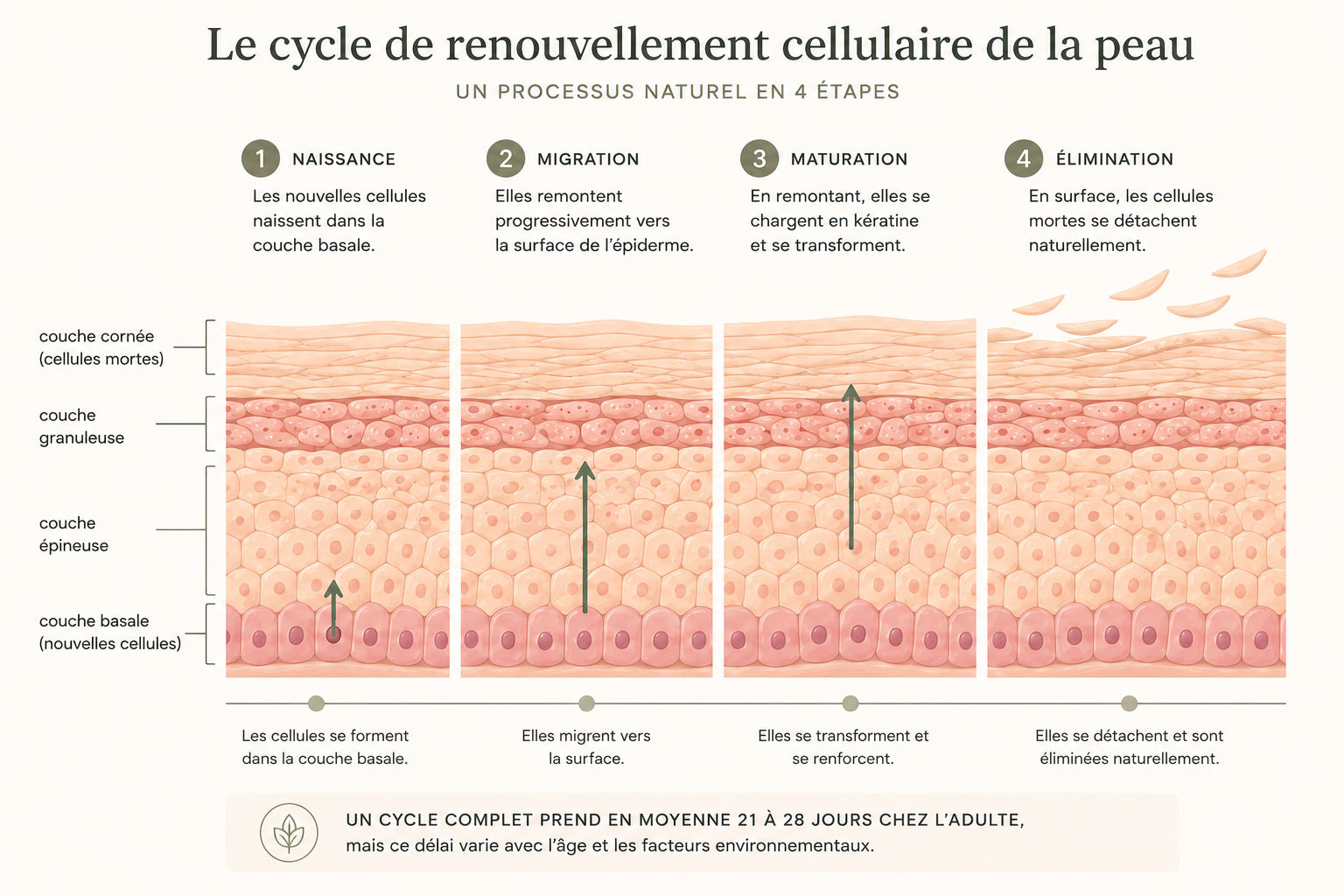
The epidermis, the outermost layer of the skin, functions as a continuous cycle.
New skin cells are created in the deeper layers of the epidermis and then gradually rise to the surface. As they rise, they become filled with keratin, become more resistant, and eventually die naturally before being eliminated.
This process is called cellular renewal.
When it functions properly, the skin appears smoother, more even and more radiant. The skin barrier also remains stronger against external aggressors such as UV rays, wind, pollution or temperature changes.
How long does it take for the skin to renew itself?
Contrary to what is often said, the famous “28-day cycle” is not a fixed rule.
The rhythm changes considerably with age.
During chilhood, the skin renews itself very quickly, sometimes in as little as two weeks.
During adolescence and early adulthood, the cycle lasts around 21 to 28 days. This is generally the period when the skin recovers the fastest.
But from around the age of 25, renewal gradually begins to slow down.
Around 30–35 years old, cells take longer to reach the surface. The complexion may become slightly less even, the skin shows signs of fatigue more easily, and recovery becomes slower after stress, lack of sleep or significant sun exposure.
After the age of 50, the slowdown becomes much more visible. Some studies estimate that a complete cycle can then take up to 60 to 80 days.
This slowdown is linked to several natural mechanisms:
- a gradual decrease in cellular activity,
- lower collagen and elastin production,
- hormonal changes,
- but also the accumulation of oxidative stress over the years.
Why spring is a key period for the skin ?
At the end of winter, the skin naturally enters a more active phase.
Light increases, temperatures become milder, and certain skin functions gradually regain better balance. Many people also notice a fresher or more radiant complexion during the first sunny weeks.
But this period also often reveals what winter has left behind: an accumulation of dead skin cells, thicker skin at the surface, or skincare products that seem to penetrate less effectively.
This is particularly true after the age of 30, when cellular renewal naturally becomes slower.
The goal is not to “force” the skin to renew itself faster at all costs, but rather to support this mechanism without weakening the skin barrier.
Should you exfoliate your skin to stimulate cellular renewal?
Yes, but with great nuance.
Exfoliation helps the skin eliminate dead cells that are already ready to detach. It therefore supports the natural renewal process, especially when it slows down with age.
The problem is that many exfoliating products today are too aggressive.
Overly abrasive scrubs, acids used too frequently, routines combining exfoliants and powerful active ingredients… Over time, the skin ends up weakened instead of strengthened.
At Siprès, we advocate a much more respectful approach to skin physiology.
A well-designed exfoliation should never strip the skin. It should simply help remove what the skin no longer needs while preserving the integrity of the skin barrier.
This is also why our facial exfoliant was formulated with a very fine grain size, under 300 microns: to exfoliate effectively without creating micro-lesions.
Once a week is more than enough in the majority of cases.
Why vegetable oils also play an essential role ?
Cellular renewal does not depend solely on exfoliation.
To produce new healthy cells, the skin also needs lipids.
More specifically, essential fatty acids naturally present in certain virgin vegetable oils.
These lipids directly contribute to the proper functioning of the skin barrier. They help the skin remain supple, comfortable and able to limit water loss.
Skin that is weakened or constantly stressed often renews its cells less effectively.
This is also why we work exclusively with fresh, cold-pressed vegetable oils sourced in Belgium and France. Their natural richness in omegas, vitamins and antioxidants helps support the skin without overstimulating it.
What the skin mainly needs with age ?
Over time, many people try to “speed up” the skin.
But in reality, mature skin often needs regularity, gentleness and consistency much more.
Effective cellular renewal does not depend solely on a powerful active ingredient.
It also depends on:
- of a skin barrier in good condition,
- of sufficiently nourished skin,
- of a well-balanced exfoliation,
- of a good sleep,
- of a reasonable solar exposure,
- and a routine that can actually be maintained in the long term.
The skin already knows how to renew itself naturally. Ultimately, the role of skincare is mainly to allow it to do so under the best possible conditions.